

LED Displays for Simulation
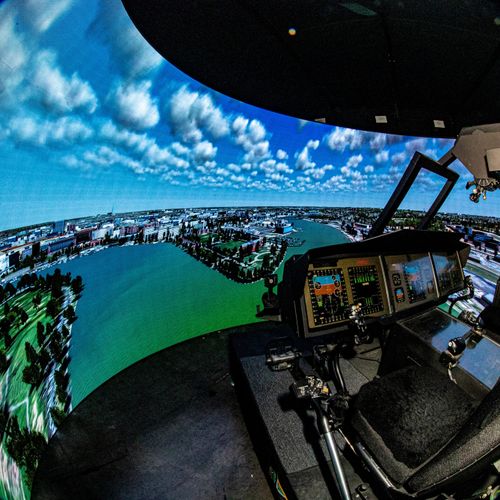
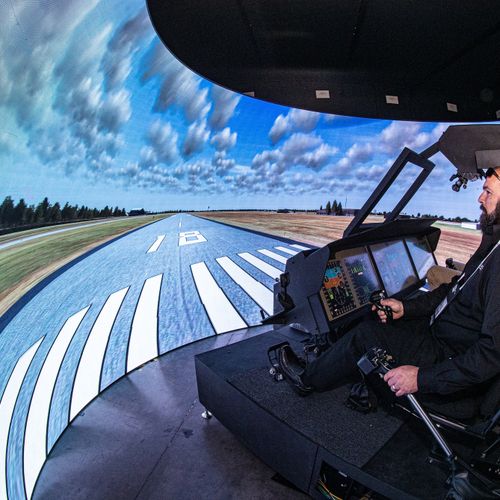
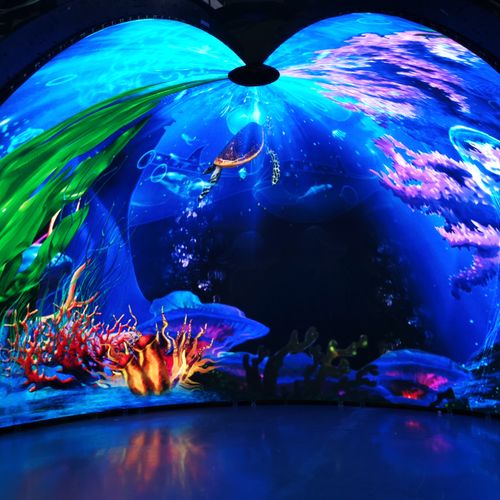
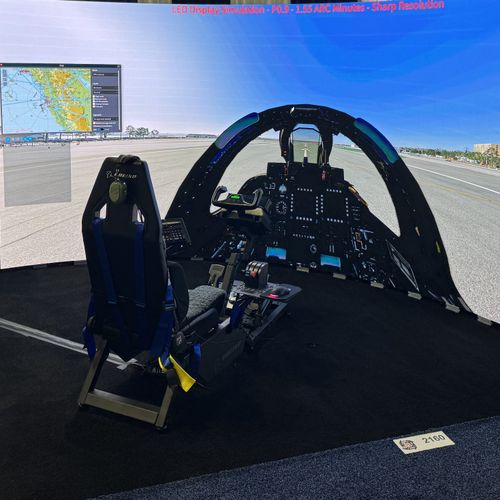
- Precision Visual Detail for Training: dvLED displays provide sharp, clear, deep, and continuous images whereas projected images can be distorted and unclear.
- Realistic Cues for Pilot Performance: dvLED supports terrain interpretation, depth perception, parallax, early runway recognition, and fine-detail visibility needed in training environments.
- Designed for Simulation Standards: Aligns with FAA, EASA, military, and FFS Level-D expectations, which score visual MTF and line-pair resolution, not raw pixel counts.
- Superior Clarity Over Projection: dvLED produces a seamless image across the display without optical edge blending, maintaining perfect pixel clarity which projection struggles to achieve.
- High-Performance Visual Characteristics: Pixel pitch, fill factor, black level, halo control, diode uniformity, color crosstalk, frame sync, and latency all influence training realism and fidelity using dvLED displays.
- Configurable for Simulation Domes: dvLED radius and pixel pitch relationships directly define arcminute performance, enabling training systems to target required acuity levels for each mission profile.
In simulation environments, visual displays carry the weight of realism, pilot performance, and regulatory expectations. The correct metric for defining visual acuity in a dome is arcminutes per optical line pair, because pilots do not perceive pixels, they perceive contrast boundaries where detail actually lives. This approach matches the behavior of human visual acuity, which resolves line pairs rather than
individual dots on a display.
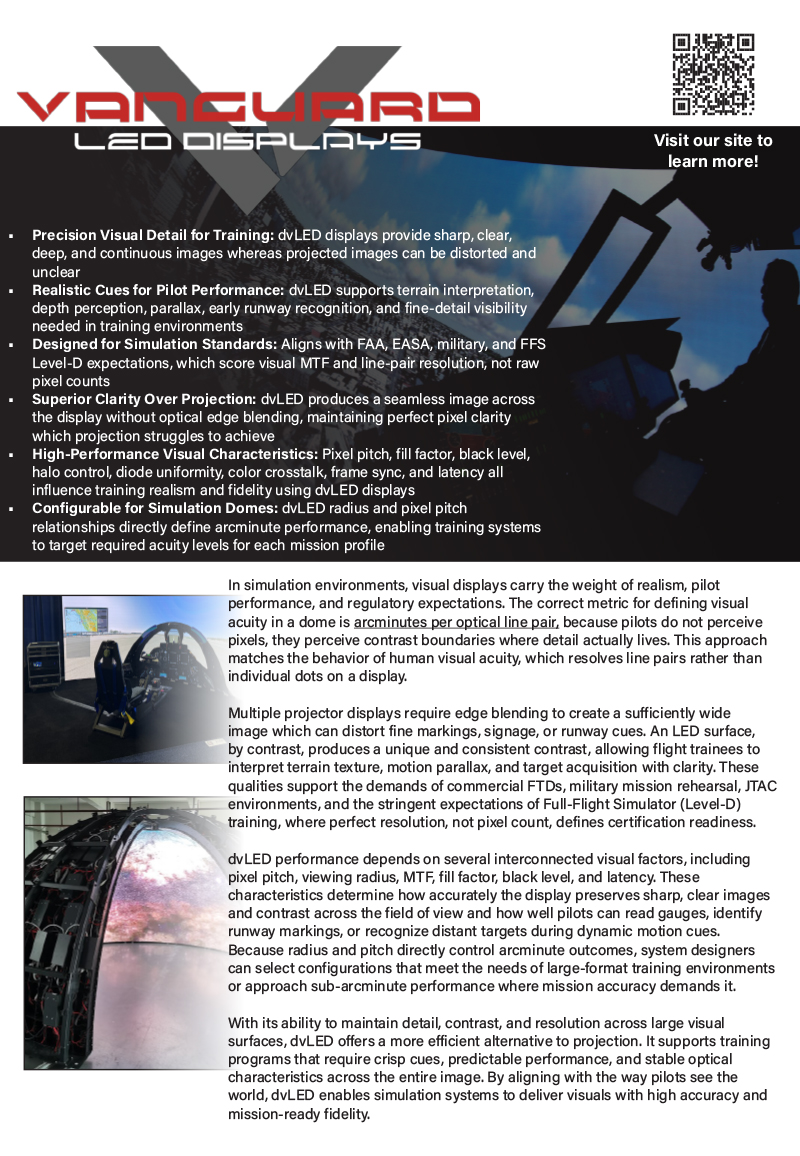
Multiple projector displays require edge blending to create a sufficiently wide image which can distort fine markings, signage, or runway cues. An LED surface, by contrast, produces a unique and consistent contrast, allowing flight trainees to interpret terrain texture, motion parallax, and target acquisition with clarity. These qualities support the demands of commercial FTDs, military mission rehearsal, JTAC
environments, and the stringent expectations of Full-Flight Simulator (Level-D) training, where perfect resolution, not pixel count, defines certification readiness.
dvLED performance depends on several interconnected visual factors, including pixel pitch, viewing radius, MTF, fill factor, black level, and latency. These characteristics determine how accurately the display preserves sharp, clear images and contrast across the field of view and how well pilots can read gauges, identify runway markings, or recognize distant targets during dynamic motion cues. Because
radius and pitch directly control arcminute outcomes, system designers can select configurations that meet the needs of large-format training environments or approach sub-arcminute performance where mission accuracy demands it. With its ability to maintain detail, contrast, and resolution across large visual surfaces, dvLED offers a more efficient alternative to projection. It supports training programs that require crisp cues, predictable performance, and stable optical characteristics across the entire image. By aligning with the way pilots see the world, dvLED enables simulation systems to deliver visuals with high accuracy and mission ready fidelity.
Resources of the Simulation
Vanguard Simulation Series
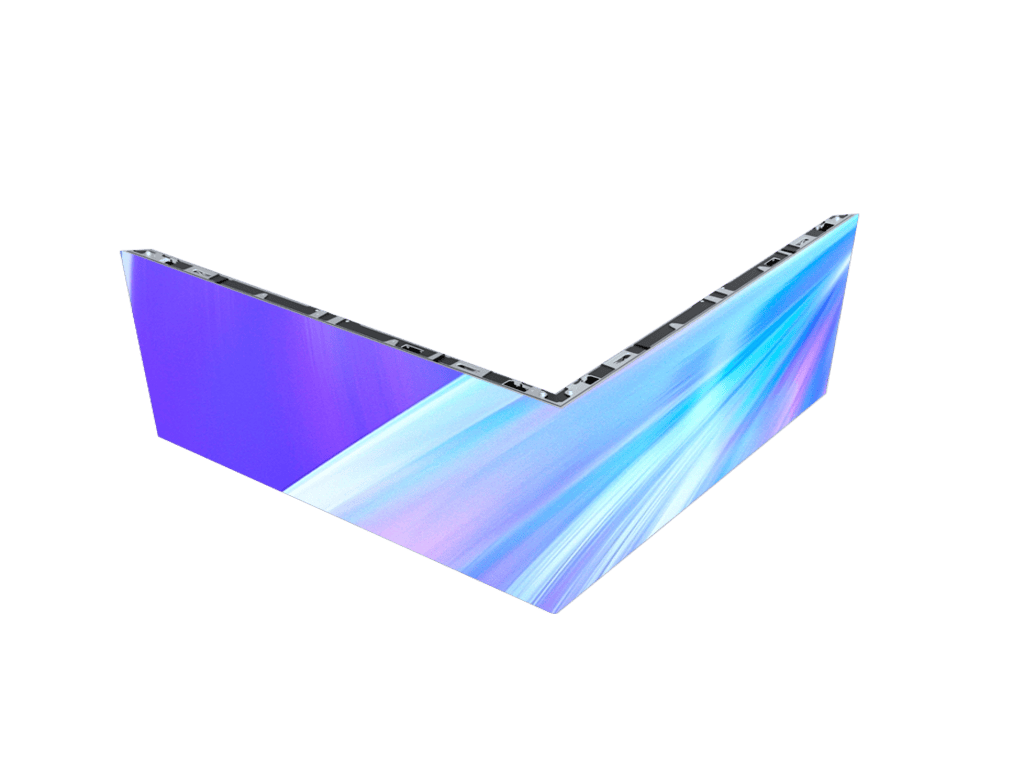
Wave
- Configurable smooth curving displays
- Concave, convex, or flat
- Fine-pitch down to 1.25mm
- Single frame size and module size
- Configurable as true 16:9, 2K, 4K, and more
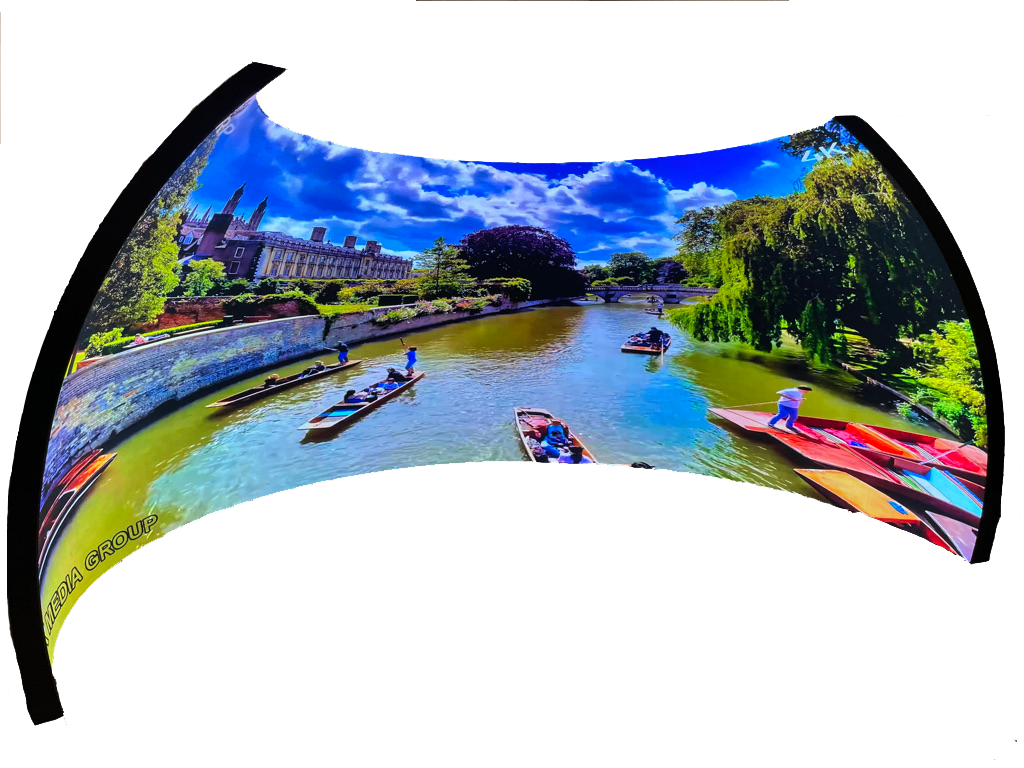
Cerium Sphere
- Sphere-shaped display
- Up to 360° field of view
- Configurable size
Frequently Asked Questions
Why is LED replacing projection in simulation and training environments?
TL;DR: LED eliminates projection's compromises — no edge blending, no shadows, true blacks, immunity to ambient light, silent operation, and no projector throw space.
What display shapes can be built for simulation environments?
We build simulation geometry two ways: our Wave series creates precision-curved walls, columns, and cylindrical environments through milled fixed-angle frames, while our Cerium series delivers full compound curvature — domes, globes, and complete spheres surrounding trainees entirely. Between them, virtually any training geometry is achievable, engineered per project.
How sharp is an LED simulation display?
As sharp as the projection it replaces — at a diameter just under 5 meters, our Cerium 0.9mm display achieves an angular resolution of 2.56 arc-minutes. At trainee viewing distance, pixel structure effectively vanishes, delivering the visual acuity that flight and vehicle training demands.
How realistic are lighting and contrast in an LED simulation environment?
Beyond what projection or LCD achieve — LED pixels turn fully off for true blacks, so night scenarios are actually dark and dawn actually breaks. The display itself produces realistic lighting effects: sun movement and shadows render on the environment and reflect accurately into the cockpit, training the eye the way the world does.
Can LED displays keep up with real-time simulation?
Yes — our simulation systems combine high refresh rates, low latency, and genlock synchronization with image generators, so movements and interactions render in real time across every panel of the environment. The scene reacts as the world would, sustaining immersion through fast-developing training scenarios.
Do LED simulation displays integrate with existing simulation software?
Yes — our displays accept standard video signal chains and integrate with the full range of simulation software platforms and image generators. Because the display is signal-agnostic, existing training content, scenario libraries, and render pipelines carry over without redesign.
What kinds of simulation programs use LED environments?
Our simulation environments serve flight and rotary-wing training, driving and vehicle operation, maritime and bridge simulation, aerospace programs, and military mission rehearsal — any discipline where trainees must experience an environment, not watch a screen. Each system is engineered to the program's geometry, resolution, and integration requirements.
What maintenance do LED simulation environments require?
Remarkably little — no bulbs to replace, no filters to clean, no projector alignment drifting between sessions, and no scheduled maintenance requirement. Spare parts ship with every system for module-level repairs, keeping training availability high and support costs predictable across years of operation.
REACH OUT TO US
Please fill out the form, and our team will get back to you as quickly as possible.
Demo Title
This will close in 50 seconds