What is the Houdini Transparent series?
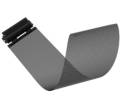
Houdini is our transparent LED display series — a soft, flexible fiberglass-based display that people see through, showing vibrant content while preserving the view behind it. With up to 90% rated transparency, no rear structure, and panels that hang freely or adhere to glass, Houdini turns windows, facades, and open air into display surfaces.
What makes Houdini stand out from regular LED displays?
Houdini is nearly invisible when idle or viewed from behind: up to 90% transparency, no rear supporting structure, and a soft, flexible fiberglass PCB instead of a rigid panel. Content appears to float on the glass — or in open air — while visibility through the display remains clear from both sides.
What pixel pitches does Houdini come in?
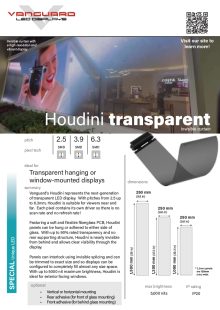
Houdini comes in four pitches — 2.5mm, 3.9mm, 6.3mm, and 10mm — and pitch selection works differently here: transparency and brightness increase with pitch. The 2.5mm delivers 70% transparency at 1,200 nits for close viewing; 3.9mm reaches 80% and 3,000 nits; 6.3mm achieves 90% transparency at 5,000 nits; and the 10mm extends the series to its longest viewing distances and most open configurations.
How transparent is a Houdini display?
Transparency scales with pixel pitch: 70% at 2.5mm, 80% at 3.9mm, and 90% at 6.3mm — the wider the pixel spacing, the more open area light passes through. Choosing a Houdini configuration means balancing viewing distance against how invisible the display should be, with even the finest pitch keeping most of the view intact.
Is Houdini bright enough for sunny windows?
Yes — Houdini reaches up to 5,000 nits maximum brightness, keeping content sharp and legible even in exterior-facing windows under direct sunlight. Brightness scales with pitch, with the high-transparency configurations delivering the most output — precisely the models suited to storefront glass.
Can Houdini be hung freely or mounted on any glass?
Both — Houdini's flexible panels adhere to either side of glass on nearly any storefront, facade, or atrium surface, and can also hang independently as a free-floating curtain with air passing through the display itself.
Should Houdini's LEDs shine through the glass or away from it?
TL;DR: LEDs can shine through the glass (display protected indoors) or face away from it (wider viewing angles, but weather-exposed on exterior windows).
Can Houdini be adjusted to unique spaces?
Yes — Houdini panels can be trimmed to exact length and interlock through a splicing connection that preserves transparency, with splices nearly invisible except from behind at certain angles. Custom windows, unusual shapes, and massive glass walls fill completely, with transparency and image quality intact.
How does Houdini's pixel drive differ from conventional LED?
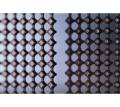
Every Houdini pixel contains its own static integrated driver — pixels are always lit rather than scanned row-by-row, eliminating scan rate entirely — while refreshing at 3,840Hz. The result is an exceptionally stable image with up to 16-bit processing depth and adjustable color temperature from 3,000K to 9,000K.
Is Houdini suitable for on-camera use?
Yes — because Houdini's pixels are statically driven, there are no scan lines by architecture, and 3,840Hz refresh keeps the image clean on video. Transparent displays photograph memorably — content appearing to float in air or on glass — making Houdini a distinctive choice for filmed events, broadcast backdrops, and social-ready installations.
Can individual Houdini pixels be repaired?
TL;DR: Yes — unlike most transparent LED, where pixel damage means discarding the module, Houdini pixels repair like standard SMD, and can even be replaced in place.
What warranty and service come with Houdini?
Houdini includes a 3-year warranty, with coverage up to 5 years available and sufficient spare parts included. Service is front-access and module-level: because glass adhesion is non-permanent, individual modules remove, repair, and reinstall without disturbing the surrounding display — maintenance as unobtrusive as the display itself.